And the link to the PWA app is in its description (with links to blank maps and some ressources).
Have fun !
And the link to the PWA app is in its description (with links to blank maps and some ressources).
Have fun !
Here is a new video about playing on VTT in a sideway AI theatre way...
This one is about the Dragonbane RPG, but it also showcase standees and a new VTT really cool app... which I recommend, other VTTs should work, but are probably difficulty overkill. ICVTT that I used until now should still be a great choice, but RPG Map has a few features more useful for the kind of games I play (1 to 1 import of assets, turning maps into isometric ones, scale that can be set with numbers instead of eyeballing...).
Using movable scenery parts extends the sideway roleplaying battlemap in depth and gives more options to the characters. Here is a full display of the results.
All the assets that appear in the video can be downloaded if you want to play the game. A always, I recommend using a simple VTT program like ICVTT, other VTTs should work, but are probably difficulty overkill.
Some weeks ago, I posted, here on the blog, character sheets that could be used with ELEMENTAL roleplaying rules.
They are intended to be used in online gaming, but there is no reason they could not be used otherwise.
They are designed to be easily modified to include an illustration of your character.
The charsheets presented then were the english version, but here are the french versions if needed.
PDF Elemental Charsheet in French
ODT Elemental Charsheet in French
But, Elemental being an universal set of rules, other charsheet styles could be prefered depending on the setting of the game.
Here is one style that I use for fantasy games:
PDF Elemental fantasy Charsheet in English
ODT Elemental fantasy Charsheet in English
PDF Elemental fantasy Charsheet in French
ODT Elemental fantasy Charsheet in French
And here is one charsheet in Dark style:
PDF Elemental dark Charsheet in English
ODT Elemental dark Charsheet in English
PDF Elemental dark Charsheet in French
ODT Elemental dark Charsheet in French
The pdf files can be used immediately but they don't have a character illustration; the odt files are intended to let you insert a character portrait and then export in pdf.
The detailed explanations to use the charsheets are in the previous post.
I wanted to present a short, well known, fantasy scenario, adapted to be played using the sideway theatrical view I have developed, using AI assets.
And which scenario could be more appropriate than the Delian Tomb, created by Matt Colville and serendipity ?
So, here it is. All the assets that appear in the video can be downloaded if you want to play the game. A always, I recommend using a simple VTT program like ICVTT, but other VTTs should work, but are probably difficulty overkill.
When playing online, I generally use ICVTT or similar simples VTTs, using paper and pens for any information that I want to keep on hand. Some players seem to prefer to have their character sheet on the screen, so, I generally make some fillable character sheets that they can use alongside the program, in another tab.
I have recently discovered Elemental, a universal RPG with a balance of detail and simplicity on the spot for what I want for scenarios for which I do not want to learn new rules system, or for scenarios using a system I do not like.
So, I made some charsheets. Here is how the result looks like. Read further to find the files for your own use.
There are two ways to use those files:
To fill that image field with an image of your choice (more or less square images are going to work best, other proportions will work though).
Open the odt file with Libre Office :
Check that you are not in design mode (Form Menu > Design Mode):
In the PDF option window that opens itself, verify that the button "Create PDF Form" is checked
And that's it. If you open the pdf form in a tab alongside your VTT page, you have a charsheet as accessible as those imbedded in other VTTs.
A review of the old Traveller scenario Uragyad'n of the seven pillars.
I have some very fond memories of it. And some nostalgia issues.
I made a lot of sideway tokens and background battlemaps to play it. I pushed the style clearly into pulps or dieselpunk atmosphere, because of the Lawrence of Arabia association.
Anyway, you can download all the assets that I produced (as usual: IA generation, Photoshop modifications and export). You'll find a link in the description of the review.
Maybe add some battlemaps turned into isometric, and you'll have more assets to play than most gamemasters are generally preparing.
I recommend the use of the ICVTT to play.
Those VTTs like Foundry are too cumbersome (Foundry particularly which expect you to have "setting the VTT right" as your hobby instead of roleplaying).
Whilst I recommended Owlbear Rodeo in the past, it has succumbed to the features bloat that programmers seem incapable to resist (not to mention the obligation of using their cloud to store your assets for playing, instead of your hard drive, limiting what is available during the game), a sad demise indeed for what was the finest VTT at one time in the past.
I am more ambivalent about Roll20, which has the fine feature of the rollable table token, but still has not understood that when you import a token, it should keep its proportions (or even size) instead of being squashed in a square. It is also a bloated VTT, but most of that can be simply ignored (which makes it better than Foundry).
Lots of people are using Artificial Intelligence to enhance their Tabletop Roleplaying experience ! But they tend to limit its use to illustrations.
Combining assets made by Artificial Intelligence programs with Virtual Tabletop Applications can make a tremendous boost to games. And not online, but mostly in face to face sessions !
Rules do not matter, it works for every atmosphere by choosing an appropriate style. Have a look at all the exemples in the video !
When playing online, I generally use Runehammer VTT, Owlbear Rodeo VTT, or similar simples VTTs, using paper and pens for any information that I want to keep on hand. Some players seem to prefer to have their character sheet on the screen, so, I generally make some fillable character sheets that they can use alongside the program, in another tab.
I had backed the test drive rules of Dragonbane and they really look to be right up my alley in style and complexity. When the final edition was released, I was a little disappointed by the differences from the test drive rules and let it down for a moment. I have gone back tot the rules and found that I could live with those changes (except maybe the rest rules, which have a quite classical problem, but that's a discussion for another day and easily solved anyway).
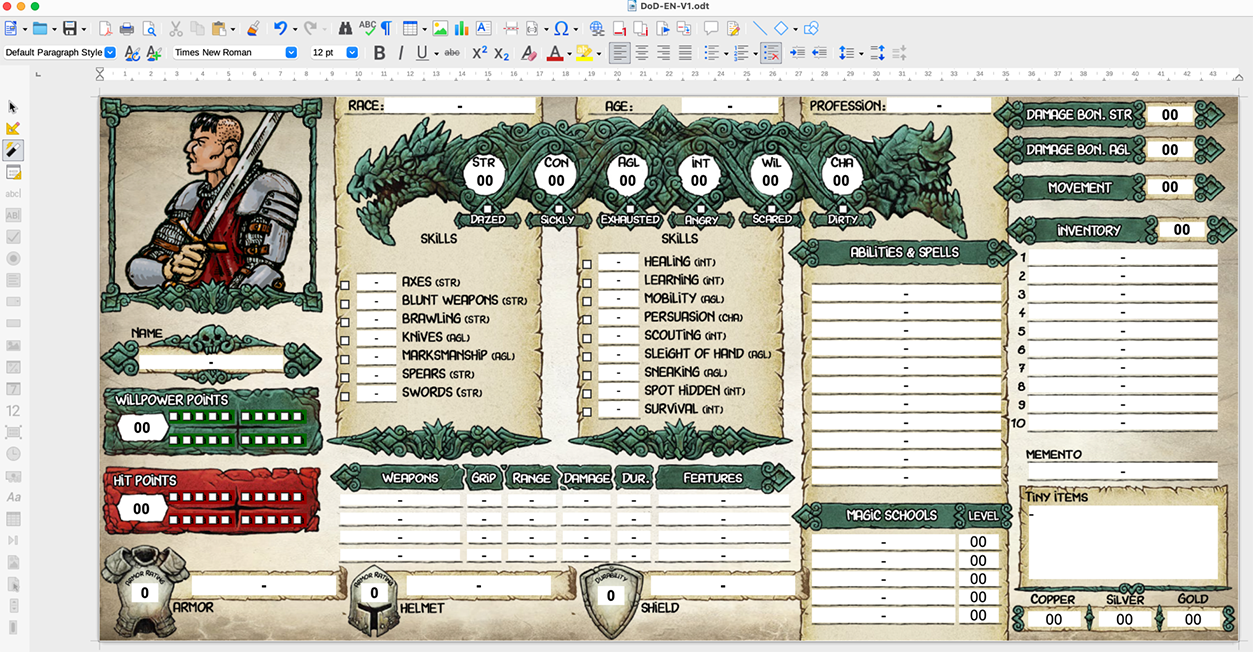
So, I decided to remake the charsheets I made for the test drive rules, but this time adapted for the final edition. The user guidances are, of course the same as those for the test drive, but they are repeated here for ease of use.
Finally, I have only the official character sheet in english. I have translated it in french myself for the french version, but I could have to remake it later if the french edition translates some things differently.
Here is how the result looks like. Read further to find the files for your own use.
To fill that image field with an image of your choice (more or less square images are going to work best), open the odt file:
Check that you are not in design mode (Form Menu > Design Mode):
And that's it. If you open the pdf form in a tab alongside your VTT page, you have a charsheet as accessible as those imbedded in other online VTTs.
If you want to take the Dragonbane style appearance a little bit further, you can make the illustration of the character in the same style as the rest of the character sheet.
To do that, you'll have to open a PSD file containing the frame with GIMP or Photoshop and export the portrait from there. I'll show how to do it with GIMP, because I assume that if you pay a monthly fee for Photoshop, you already know how to use it (and the steps are the same anyway).
Step 1: Open the PSD DoD-Portrait file with GIMP:
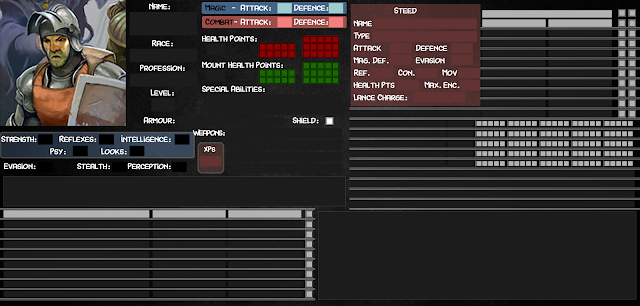
This blog post was made for the test rules released during the Kickstarter Dragon bane campaign. The character sheet of the finale release is different. This post is then obsolete and is replaced by a newer one taking into account the new modified character sheet.
You'll find it here:
https://toybox-sw.blogspot.com/2024/04/dragonbane-fillable-character-sheets.html
When playing online, I generally use Owlbear Rodeo VTT, Runehammer VTT or similar simples VTTs, using paper and pens for any information that I want to keep on hand. Some players seem to prefer to have their character sheet on the screen, so, I generally make some fillable character sheets that they can use alongside the program, in another tab.
I have recently backed the test drive rules of Dragonbane and they really look to be right up my alley in style and complexity (except maybe the rest rules, which are quite classical, but that's a discussion for another day and easily solved anyway).
So, I decided to make some charsheets, but contrary to my usual black background, I used graphic elements from the official character sheet, because I found them so gorgeous.
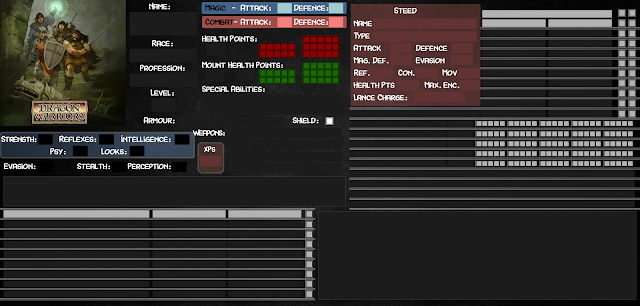
Here is how the result looks like. Read further to find the files for your own use (files provided with the authorisation from Free League, of course).
There are three ways to use those files:
To fill that image field with an image of your choice (more or less square images are going to work best), open the odt file:
- odt file of the charsheet in Libre Office -
Check that you are not in design mode (Form Menu > Design Mode):
In the PDF option window that opens itself, verify that the button "Create PDF Form" is checked.
And that's it. If you open the pdf form in a tab alongside your VTT page, you have a charsheet as accessible as those imbedded in other online VTTs.
If you want to take the Dragonbane style appearance a little bit further, you can make the illustration of the character in the same style as the rest of the character sheet.
To do that, you'll have to open a PSD file containing the frame with GIMP or Photoshop and export the portrait from there. I'll show how to do it with GIMP, because I assume that if you pay a monthly fee for Photoshop, you already know how to use it (and the steps are the same anyway).
Step 1: Open the PSD DoD-Portrait file with GIMP:
There is, of course, no obligation to use digital character sheets whilst playing online.
A simple sheet of paper on your desk can easily do the trick. It is certainly enough for my notes and for tracking PCs, NPCs, scenario info... but some players prefer to have their character's info on the screen, alongside the VTT display. So, why not?
Some of the most used online VTTs provide sheets that you can use within the program, more or less customizable, more or less limited and more or less available, depending on the VTT and the game played.
There are two BIG problems with those embedded sheets. The first one is that you have to fill lots of stuff on those sheets, because peoples designing them never think there is enough information on them.
The second one is that if you play one of the games for which no charsheets are provided, you are out of luck. You'll have to setup one yourself in a programming language that is generally not intuitive, and with almost no control on the look and usability of the sheet.
It can be quite frustrating, but, you don't have to use those.
There is a far easier way to have online charsheets and in a very simple way: using simple PDF forms that you can generally find online for your favorite game, or that you can produce yourself by making a form in Open Office or Libre Office (in odt format) and export as a PDF form.
Making PDF forms is really easy: you make an image of the form you want to design. Set it as background in Open Office or Libre Office. And then place the fields you want onto it (bullets, check boxes, text, images...). Let's have a look at the result.
Here is the exemple of the charsheet I have made for Lamentations of the Flame Princess. As you can see, the page setup is in landscape format to be in the same orientation as a screen.
And there is a space for an illustration of the character, which means that there is an image field in the odt form (obviously).
To fill it, open the odt file (sample files are found at the end of this post to let you try it). Note that if you make charsheets where there is no illustrations to place, you can directly use the PDF in your browser without going through the odt first, but it is less funny...).
- odt file of the charsheet in Libre Office -
Check that you are not in design mode.
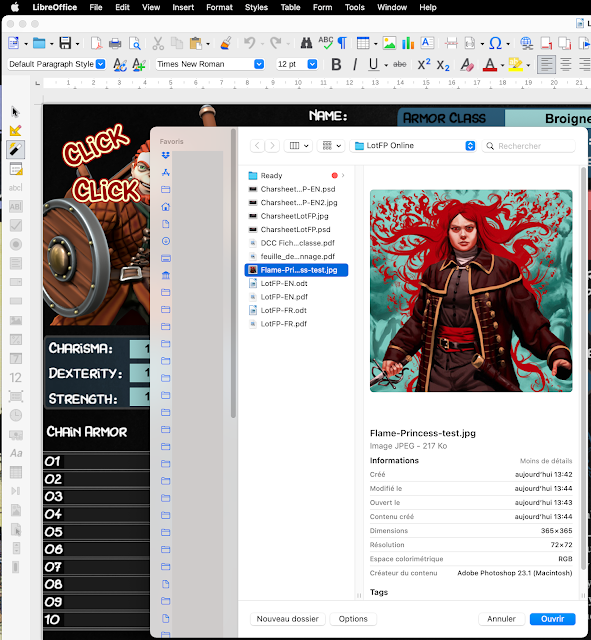
Double click on the illustration field and choose an illustration, ideally more or less square (to avoid black areas padding the image, but it will work with any proportions of image).
Export as pdf form (check that form is active).
And that's it. If you open the pdf form in a tab alongside your VTT page (on Owlbear Rodeo, preferably, it is the best one available -and free- at the moment), you have a charsheet as accessible as those imbedded in other online VTTs, but much more flexible, easier to produce, and adapted to YOUR game and tastes. And if you need special sheets to add for certain class of characters (sheets with lists of spells, for exemple...), you can always make one that the player can open in another tab.
Indeed, any information that a player may want to have available can be turned into a pdf, fillable or not, that can be opened in a different tab. The difference here, with the sheets offered by VTTs like Roll20 or Foundry, or .... is that here you only have what you want, in the way you want, and each player can have his own setting without having to use a predefined one.
CAVEAT: When you have finished using the form in your browser, don't forget to save it WITH the changes. If you just close it, they will be lost. It is probably a good idea to save regularly your progresses (yes, we all know that and still...).
If you don't want to go through Open Office or Libre Office to export PDF forms customized with an illustration of the character, you can just do it once and place the logo or the cover of the game as an illustration. And then use directly copies of the same pdf for every player.
But, above all, remember: it is not because something can be turned into a digital format that it must be, and papers and pencils are still the most versatile way to record information. But, of course, YMMV....
If you want to experiment a little, here are the LotFP sheets (english and french) in odt, and the samples in pdf that you can open directly and fill in your browser.